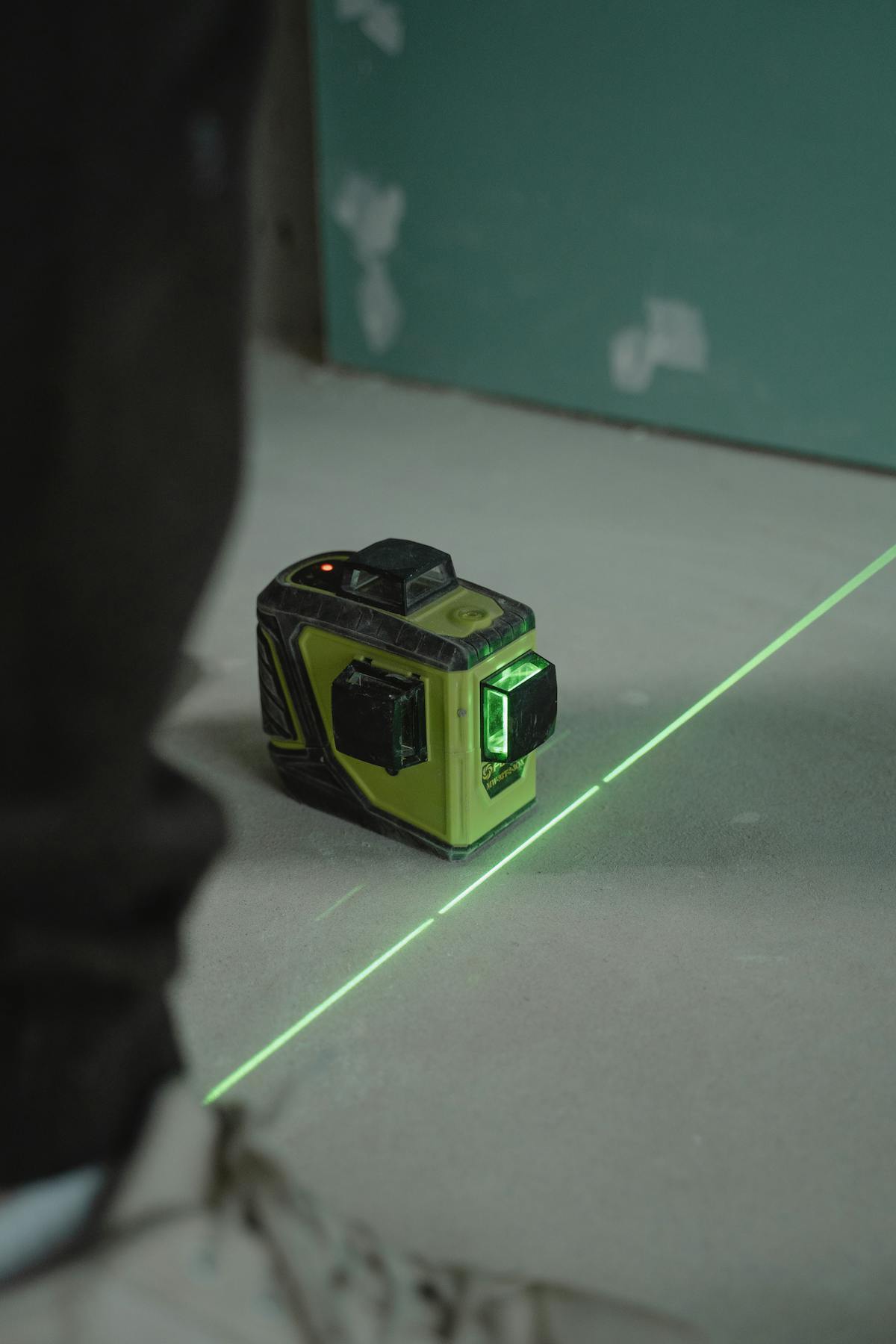
Green vs Red Laser Level: Which Is Better for Your Projects?
Laser levels have transformed how DIYers and professionals handle layout tasks, from hanging pictures to tiling entire floors. But walk into any hardware store and you’ll face a fundamental choice: green laser or red laser? The color difference isn’t just cosmetic — it affects visibility, battery life, accuracy, and price. Let’s break down the real-world differences to help you choose the right one.
The Science Behind Laser Color
Green lasers operate at a wavelength of 532nm, which falls right in the peak sensitivity range of the human eye. Red lasers operate at 635-650nm, which our eyes are less sensitive to. This means a green laser beam appears approximately 4 times brighter than a red beam of the same power output. This isn’t marketing hype — it’s physics, and it has significant practical implications for your work.
Visibility Comparison
Indoor Use: Both green and red lasers are clearly visible in typical indoor lighting conditions up to about 30 feet. Green gains a noticeable advantage in brightly lit rooms, large open spaces, and when working at distances beyond 30 feet. For most home projects like hanging pictures, installing cabinets, and tiling, either color works fine.
Outdoor Use: This is where green lasers truly shine — literally. In direct sunlight, green lasers remain visible at distances up to 3-4 times farther than red lasers. If you’re doing any outdoor layout work such as grading, fence installation, or deck building, green is the clear winner. Red lasers are essentially invisible outdoors without a detector.
Battery Life
Red lasers have a significant advantage in battery efficiency. A typical red laser level runs 20-40 hours on a set of AA batteries, while comparable green laser levels run 8-15 hours. Green laser diodes require more energy and generate more heat, which also means they may perform less consistently in extreme cold temperatures. If you need extended run time or work in cold environments, red lasers hold the edge.
Accuracy
At the laser level itself, both colors offer identical accuracy — typically ±1/8 inch at 30 feet for consumer models and ±1/16 inch at 30 feet for professional models. The practical accuracy difference comes from visibility: if you can see the green line more clearly, you can align to it more precisely, especially at longer distances or in bright conditions.
Price Comparison
Green laser levels typically cost 20-40% more than equivalent red laser models. A quality red cross-line laser level starts around $40-60, while comparable green models begin at $60-100. For premium self-leveling rotary lasers, the gap widens further. However, prices have dropped significantly over the past few years as green laser diode technology has matured.
Related Articles
- How to Build a DIY Workbench: Tools You Actually Need
- Power Tool Safety Gear: Essential Protection for Every Workshop
- Extension Cord Guide for Power Tools: Wire Gauge, Length, and Safety
Our Recommendation
Choose Green if: You work in bright indoor environments, do any outdoor layout work, need to see lines at longer distances, or want maximum visibility for precise alignment tasks. The extra cost is justified by the dramatically improved visibility.
Choose Red if: You primarily work in typical indoor lighting, need maximum battery life, work in very cold conditions, or want to save money. For most standard home improvement tasks in normal indoor lighting, a red laser level performs perfectly well.
Our Pick: For most homeowners tackling varied projects, we recommend investing in a green laser level. The improved visibility translates to faster, more accurate work, and the price premium has narrowed enough that the value proposition is strong for anyone who uses a laser level regularly.
Wish I had found this article before buying a cheap laser level that was off by 1/4 inch over 30 feet. Ended up getting the DeWalt DW088K and it’s perfect.