Best Wood Routers for Beginners in 2026: Top 3 Picks Reviewed
Whether you’re trimming edges, cutting dadoes, or carving decorative profiles, a good wood router is one of the most versatile tools in any workshop. With so many models on the market, it can be tough to know where to start — especially as a beginner. This guide breaks down the three best wood routers for beginners in 2026, covering cordless, corded, and plunge options at different price points.
Why Choosing the Right Router Matters
A router is fundamentally a high-speed rotating motor that drives a cutting bit through wood. The difference between a beginner-friendly router and a frustrating one often comes down to features like variable speed control, smooth depth adjustment, and a comfortable grip.
For beginners, three specs matter most: horsepower (more power handles larger bits without bogging down), RPM range (variable speed lets you match the tool to the material), and base type (fixed-base routers are easier to control for edge work, while plunge routers let you start cuts mid-workpiece). The three routers below nail these criteria at different price points.
Quick Comparison
| Product | Best For | Price | Buy |
|---|---|---|---|
 DeWalt DCW600B DeWalt DCW600B |
Cordless convenience | ~$149 | Check Price |
 Bosch 1617EVSPK Bosch 1617EVSPK |
Best overall value kit | ~$199 | Check Price |
 Makita RP2301FC Makita RP2301FC |
Pro-grade plunge routing | ~$259 | Check Price |
1. DeWalt DCW600B — Best Cordless Router for Beginners
The DeWalt DCW600B is one of the most beginner-friendly routers available today. It runs on DeWalt’s 20V MAX battery system, so if you’re already in that ecosystem, you get a cord-free router that delivers serious performance. The brushless motor pushes speeds from 16,000 to 25,500 RPM — more than enough range for both delicate trim work and aggressive edge profiles.
The depth adjustment is tool-free and smooth, with clear depth markings that make precise settings easy to hit. Dual LED lights illuminate the cut zone, which beginners often underestimate until they try routing in a dim garage workshop. The motor brake stops the bit within seconds of releasing the trigger — a safety feature that builds good habits early. At around $149 for the bare tool, it’s an excellent entry point if you already own 20V MAX batteries.
2. Bosch 1617EVSPK — Best Value Combo Kit
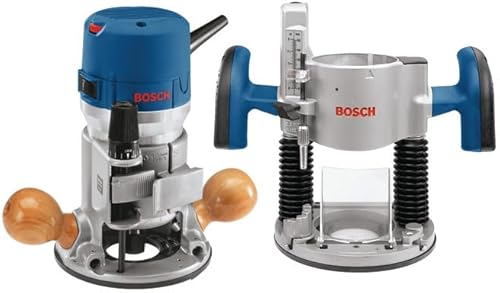
The Bosch 1617EVSPK has been a woodworking staple for over a decade, and for very good reason. This combo kit includes both a fixed base and a plunge base that share the same 2.25 HP motor unit, giving you the functionality of two routers for one price. The electronic variable speed control runs from 8,000 to 25,000 RPM — a wide range that lets you match bit speed to material with genuine precision.
Both 1/4-inch and 1/2-inch collets are included, opening up the full spectrum of router bits without needing adapters. The Bosch handles extended sessions without overheating, thanks to its well-designed motor cooling system. The cam-lock depth adjustment on the fixed base is precise and repeatable, while the plunge mechanism offers smooth, consistent travel. At around $199 for the full kit with carrying case, this is exceptional value. Woodworkers who start with this Bosch often keep it for ten years or more.
3. Makita RP2301FC — Best Plunge Router for Serious Beginners
If you want a dedicated plunge router that performs at a professional level from day one, the Makita RP2301FC is the one to get. This 3-1/4 HP corded router runs from 9,000 to 22,000 RPM with electronic variable speed and a soft-start feature that eliminates the initial torque jolt when the trigger is pulled. For beginners still developing their tool control, that soft start makes a real difference on the first few cuts.
The plunge mechanism is silky smooth with a rack-and-pinion depth adjustment system and three-step depth stop turret — you can preset three different plunge depths for stepped operations without recalibrating. Built-in LED lights and a quick-acting electric brake round out the feature set. At around $259, it costs more than the other options on this list, but the Makita builds skills and habits that carry into advanced work. It’s the router to buy if you’re serious about woodworking and don’t want to upgrade in 18 months.
Buying Guide: What to Look For in a Beginner Router
Horsepower: For typical edge routing, dadoes, and rebates, 1.25 to 2 HP is sufficient. If you plan to use large-diameter bits like panel raisers or cope-and-stick sets, aim for 2.25 HP or more. Running a big bit on an underpowered router strains the motor and produces rough, inconsistent cuts.
Fixed vs. Plunge Base: Fixed-base routers are simpler to set up and ideal for edge profiling and guided cuts. Plunge bases let you enter the workpiece from above, which is essential for mortises, inlays, and template routing. If you’re unsure which you need, the Bosch 1617EVSPK’s dual-base kit covers both scenarios in a single purchase.
Collet Size: Most beginner routers include a 1/4-inch collet. Look for a model that also accepts a 1/2-inch collet (or includes one), since professional-grade bits typically have 1/2-inch shanks that reduce vibration and improve cut quality.
Cordless vs. Corded: Cordless routers like the DCW600B are ideal for on-site trim work or when moving between workstations. Corded models deliver unlimited runtime and consistent power regardless of battery state. For a primary shop router, corded usually makes more practical sense.
Final Verdict
For most beginners, the Bosch 1617EVSPK is the best all-around choice — the fixed/plunge combo kit gives you maximum flexibility at a genuinely fair price. If you’re on the DeWalt 20V platform, the DeWalt DCW600B adds cordless convenience in a compact package. And if you want a router that will grow with your skills for years to come, the Makita RP2301FC is worth every dollar. Getting hands-on with a quality router will transform your woodworking projects in ways that few other tools can match.